

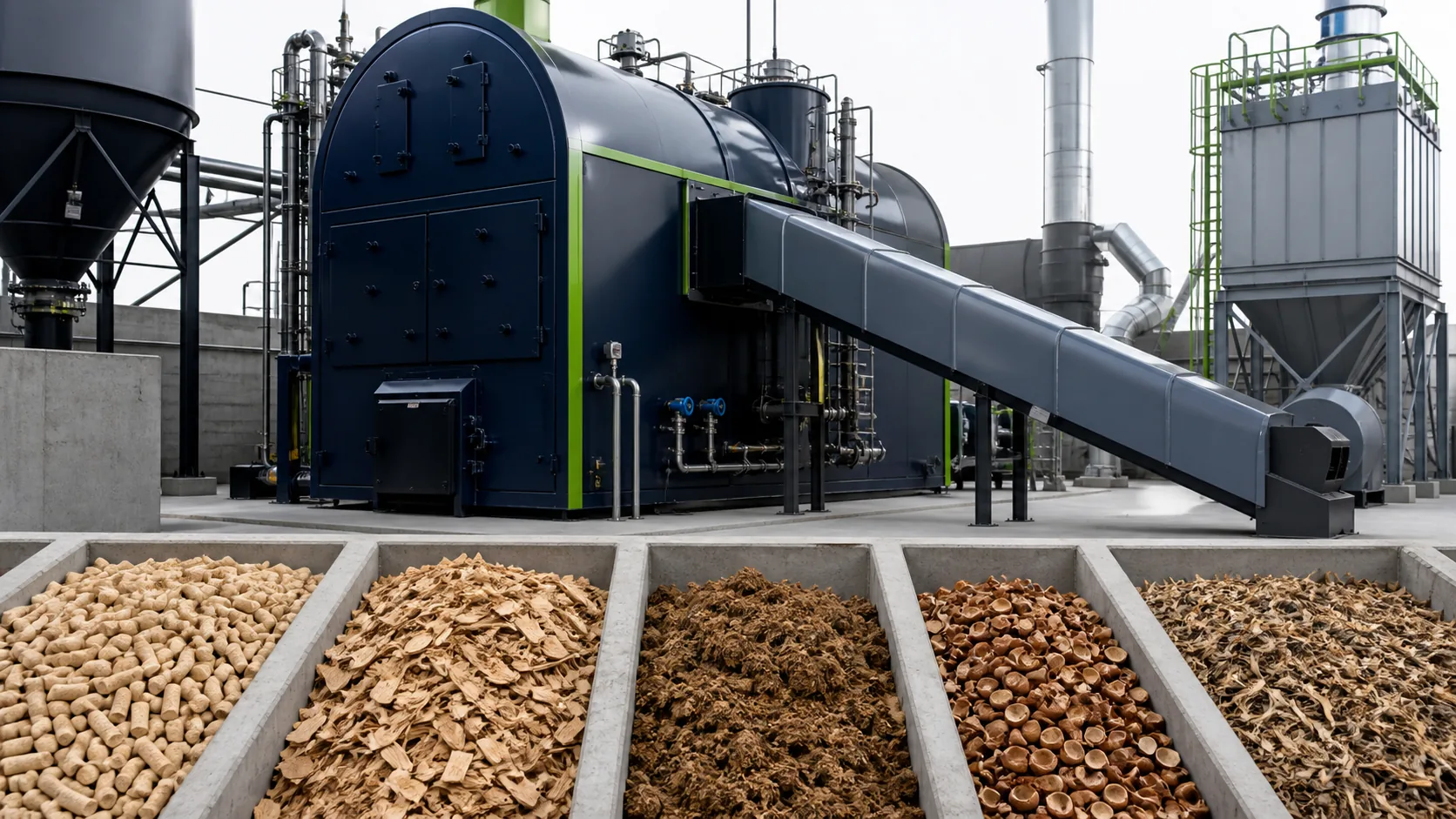
It is not only the label of the boiler that determines the efficiency of a biomass boiler. Although pellets, sawdust, wood chips, pomace, hazelnut shells and sunflower shells are mentioned in the same fuel class, moisture, ash, density, grain size and ash melting behaviors are different. A feeding and combustion system that works well for one fuel may experience capacity loss, slagging or emission problems with another fuel.
The correct approach is to first perform a representative fuel analysis and then select the boiler and combustion system based on this result.
Values to be examined in biomass fuel
Humidity
Energy is spent to evaporate the water in the fuel. As humidity increases, combustion temperature and usable heat may decrease and more flue gas may be produced. Highly variable humidity makes air-fuel balance difficult for automation.
Humidity should be considered not only in the laboratory report, but also in conjunction with storage and seasonal conditions. Chips or agricultural residues waiting in open areas can be turned into different fuels with rainfall.
Lower calorific value
The lower calorific value is the basic information about the energy that can be practically utilized from the fuel. Boiler capacity calculation should be made by analyzing the fuel to be used, not by the general declaration of the supplier.
Ash content and ash composition
As the ash increases, the transportation, storage and disposal burden increases. Not only the amount of ash, but also its melting temperature and chemical composition are important. Ash with low melting temperature can form slag on the grill and heat transfer surfaces.
Particle size and density
Powder, pellets, husks and chips do not move the same way in the same auger or grid. The risks of bridging, jamming, burnback and irregular feeding should be evaluated together with the silo geometry.
Volatile substance and element analysis
Volatile matter affects the distribution of combustion in the furnace. Nitrogen, sulfur, chlorine, alkali metals and other components can alter the risk of emissions, corrosion and deposits.
Common biomass fuels
| Fuel | Highlight | Needs attention |
|---|---|---|
| Wood pellet | Homogenous size and ease of feeding | Quality class, ash and mechanical strength |
| Sawdust | Can be local and economical | Moisture, dust, low bulk density |
| Wood chip | Accessible in forest/wood plants | Variable size and moisture |
| Pomace | May be advantageous in olive regions | Moisture, oil residue, odor and ash behavior |
| Hazelnut shell | Can provide relatively good energy density | Grain distribution and regional supply |
| Sunflower husk | Agricultural residue evaluation | Ash, alkaline component and slagging |
The table is general in nature. Current laboratory analysis is required for commercial decision.
Which combustion system to choose?
Stoker system
Stoker steam boiler can be used in homogeneous and granular fuels suitable for mechanical feeding. Stable operation of the auger, burnback protection and fuel level is important.
Forward thrust grill
In the forward thrust steam boiler the fuel proceeds through drying, gasification and combustion zones on the grate. Separate control of air zones and forward speed can be advantageous with variable solid fuels.
Rotary grill
Rotary grate boiler can be used in applications where continuous fuel feeding and ash discharge are required. Screen load, fuel size and ash behavior must be compatible.
Fluidized bed
Fluidized bed steam boiler can provide fuel flexibility and controlled combustion. Bed material, fluidization rate, fuel preparation and ash management require more complex control.
Can the fuel be changed?
Just because a boiler can “burn biomass”, an uncontrolled transition between all biomass cannot be made. When the moisture, calorific value, grain size and ash of the new fuel change:
- Fuel supply flow rate,
- Primary and secondary air distribution,
- Grill speed or bed adjustment,
- Fan capacity,
- Flue gas flow rate,
- Ash transport system,
- Filter load
It should be re-evaluated. If a fuel mixture is to be used, continuity of the mixture ratio must be ensured.
Storage and supply security
There may be risks of moisture, biological heating, dust explosion, fire and carbon monoxide accumulation in biomass stocks. Silos and warehouses; It should be designed with ventilation, temperature/CO monitoring, fire detection and safe discharge system according to the behavior of the fuel.
Screws and conveyors must have a burn-back prevention cut-out, cell wheel, temperature detection or other safety layers appropriate to the project. The operator should be prevented from interfering with the blockage on the operating equipment.
Common problems that reduce productivity
- Fuel moisture is higher than the design value,
- Feed fluctuation due to irregular grain size,
- Insufficient or excessive combustion air,
- Slag layer on the grid,
- Ash accumulation on heat transfer surfaces,
- High oxygen or unburned carbon in flue gas,
- The boiler constantly operates at very low load,
- Ash and fuel laboratory analysis is not up to date.
Simply increasing fan speed to smooth combustion can magnify excess air loss and particle carryover. Flue gas analysis, unburned matter in the ash and bed/grid observation should be evaluated together.
Why is the filter system selected together with the fuel?
Particle size and load vary depending on the fuel and combustion system. Selection of Multicyclone, bag filter, wet filter or electrostatic filter; It should be done according to target emission, gas temperature, humidity, chemical composition and operating order.
Fuel file to be prepared before requesting an offer
- Full fuel analysis from representative sample,
- Annual and daily available amount,
- Seasonal humidity change,
- Minimum/maximum grain size,
- Storage and transportation method,
- Mixture ratio of fuels,
- Ash removal method,
- Desired steam flow rate and pressure,
- Daily operation and load profile.
Hisarmak’s biomass fueled steam boiler solutions are evaluated according to the actual properties of the fuel and the process need.
Frequently asked questions
What is the most efficient biomass fuel?
There is no single answer. In addition to the calorific value, price, moisture, ash, supply continuity, preparation and filter costs should be calculated together.
Can pellets be burned in a coal boiler?
Fuel should not be changed without manufacturer approval and technical evaluation. Feed, air, grill, stove volume and emission system may be incompatible.
Why does moist fuel reduce capacity?
Part of the fuel energy is spent on heating and evaporating water; combustion temperature and usable heat may decrease.
Is fuel analysis done once sufficient?
No. Fuel properties may change as supplier, site, harvest and storage change. Acceptance criteria and a periodic sampling plan should be established.
Technical resources
- T.R. Ministry of Energy and Natural Resources, Combustion Plants, Fuels and Combustion training resources.
- Public/university technical publications on biomass energy plants and fuel characterization.