

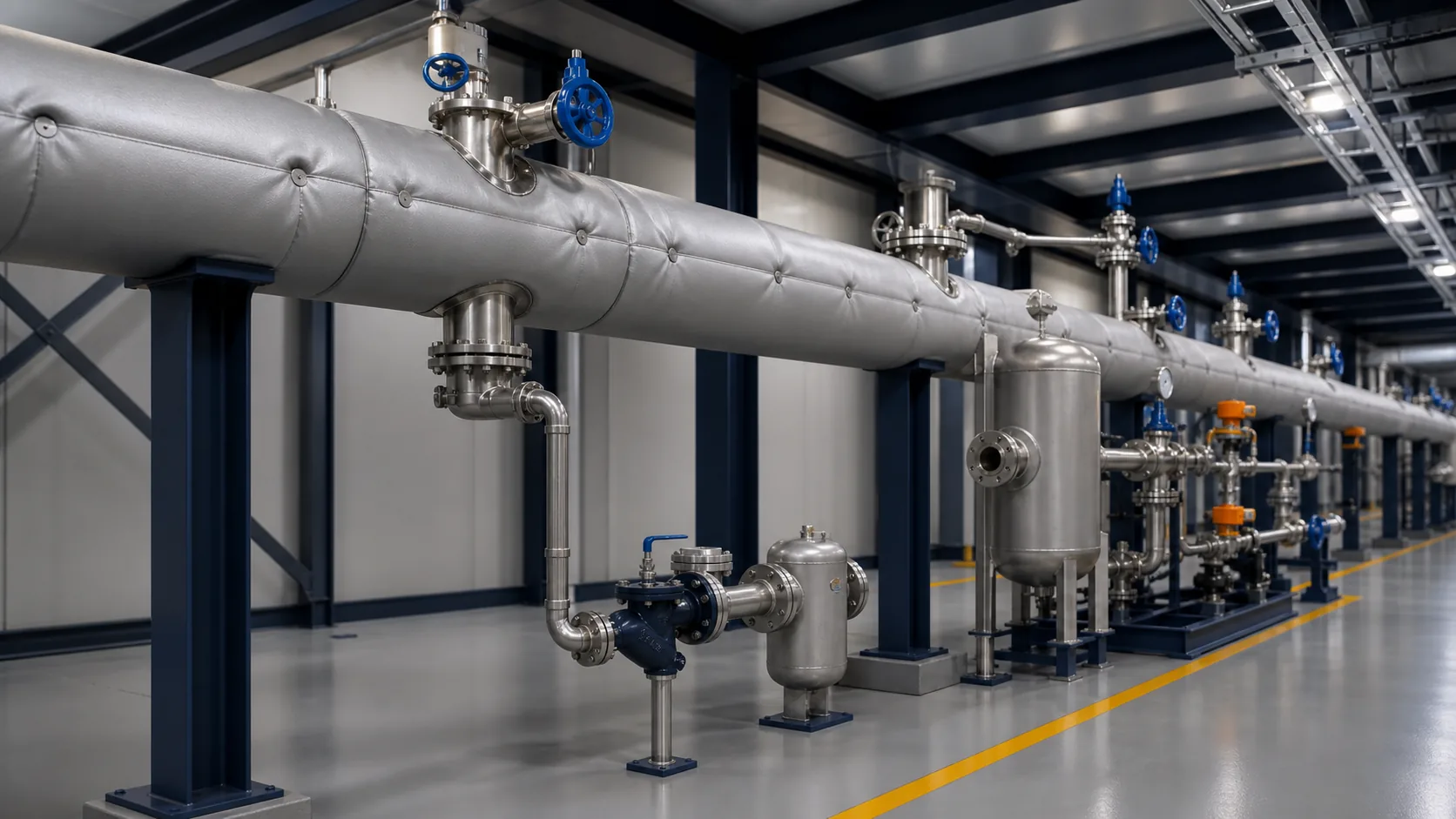
Producing enough steam in the boiler does not mean that dry steam will reach the process point at the right pressure. Wrong diameter pipe, inadequate drainage, faulty branch and improper steam trap selection; It may cause pressure loss, noise, erosion, water hammer and fluctuation in production quality.
The steam distribution line is not independent from the steam boiler; It is a system that must be designed together with production and condensate return.
How to determine the diameter of the steam pipe?
Pipe diameter is not chosen solely based on the boiler outlet. The account requires the following data:
- Normal and maximum steam flow rate to be transported,
- Inlet and usage pressure of the line,
- Saturated or superheated steam,
- Pipe length and equivalent armature losses,
- Permissible pressure drop,
- Target steam rate,
- Insulation and environmental conditions,
- Future capacity increase.
Preliminary diameter calculation according to speed can be made using mass flow rate and specific volume of steam. Then the actual inner diameter, standard pipe size and total pressure loss should be checked.
Results of small and large diameter
Steam velocity and pressure loss increase in a pipe that is smaller than necessary. Noise, erosion and vibration may occur in valves and elbows. The process may not receive the required steam even though it is available in the boiler.
Pipes that are larger than necessary increase investment and insulation costs. Due to the large surface, heat loss and the amount of condensate formed at first start-up may increase. That’s why the “big pipe is safer” approach is not correct.
Line slope and condensate pockets
Condensate constantly forms as the steam line heats up and during operation. The line should be laid with a slope that will allow the condensate to flow to the designated drainage points. On long lines, appropriate condensate pockets are planned at rise points, at the end of the line and before the control valves.
The condensate pocket should be taken from under the main pipe; It must have a geometry that will prevent the accumulated water from being dragged again by high-speed steam. The drainage group usually includes a strainer, appropriate valve arrangement, trap, check valve and testing facility.
Why is the branch taken from the top of the pipe?
If the process branch is taken from under the main steam line, the condensate progressing at the bottom can be transported to the point of use. The branch taken from the top and directed appropriately provides drier steam. Drainage and separator needs before branching should be evaluated according to load and line conditions.
steam trap selection
The task of the steam trap is to limit the loss of live steam while evacuating condensate and air. The behavior of thermodynamic, mechanical and thermostatic types is different. In the selection:
- Normal and start-up condensate load,
- Inlet and outlet pressure,
- Variable back pressure,
- Air evacuation need,
- Risk of freezing and water hammer,
- Ease of maintenance and testing
It should be taken into consideration.
It is wrong to choose a steam trap based only on the connection diameter. A large trap may increase live steam loss, while a small trap may increase condensate accumulation.
Why does water hammer occur?
Water hammer may occur when the condensate mass accumulated in the line is dragged by high-speed steam and hits a valve, elbow or another body of water. Sudden condensation can also create a low pressure zone and cause a severe impact.
Symptoms; knocking noise, pipe movement, flange leakage, hanger damage and recurring trap failures. Randomly turning the valve down to reduce the sound can hide the problem; The reason why condensate accumulates must be found.
Methods to prevent water hammer
- Opening the steam valves in a controlled and gradual manner,
- Giving appropriate slope to the line,
- Establishing condensate pockets and drainage at correct intervals,
- Selecting traps according to capacity and back pressure,
- Taking the branches from the upper part of the main line,
- Using connections that do not accumulate condensate in diameter reductions,
- Calculating expansion and pipe supports in long lines,
- Regularly testing defective traps,
- Using a separator at necessary points.
Pressure reducing station design
The pressure reducing valve is not a stand-alone station. Depending on the application, a separator, strainer, drainage, pressure indicators, safety valve, control valve and bypass arrangement may be required. The valve diameter does not have to be the same as the pipe diameter; It is selected according to the flow rate and pressure ratio.
Since the specific volume of the steam increases after the valve, the outlet pipe often has a different diameter than the inlet. Speed and noise should be controlled.
Insulation and commissioning
An uninsulated line not only loses energy; produces more condensate. Valves and flanges should not be left open all the time for maintenance reasons; detachable insulation jackets can be used.
During the first commissioning, the condensate load is higher than in normal operation because the line is cold. The main valve should be opened slowly, drains should be observed and the line should be heated gradually. Rapid pressurization increases the risk of thermal stress and water hammer.
Hisarmak’s mechanical installation and assembly works include the combined evaluation of the steam and condensate system between the boiler and the points of use.
Frequently asked questions
Can the steam pipe diameter be found only from kg/h value?
No. In addition to the flow rate, pressure, steam type, line length, fixtures, speed and allowable pressure loss are required.
What should be done if there is knocking in the steam line?
The line should be evaluated safely and condensate accumulation, slope, drainage, trap and valve usage errors should be investigated. Severe impact should not be considered normal.
How can you tell if the steam trap is working?
Only external surface temperature is not enough. An ultrasonic/temperature measurement and test procedure appropriate to the trap type and operating cycle should be used.
Why does the main steam valve open slowly?
Provides controlled heating of the cold line and discharge of the first condensate; Reduces sudden pressure and temperature changes.
Technical resources
- T.R. Ministry of Energy and Natural Resources, Steam and Condensate Systems training resources.
- T.R. Ministry of Environment, Urbanization and Climate Change, Heating Installation technical specification draft.