

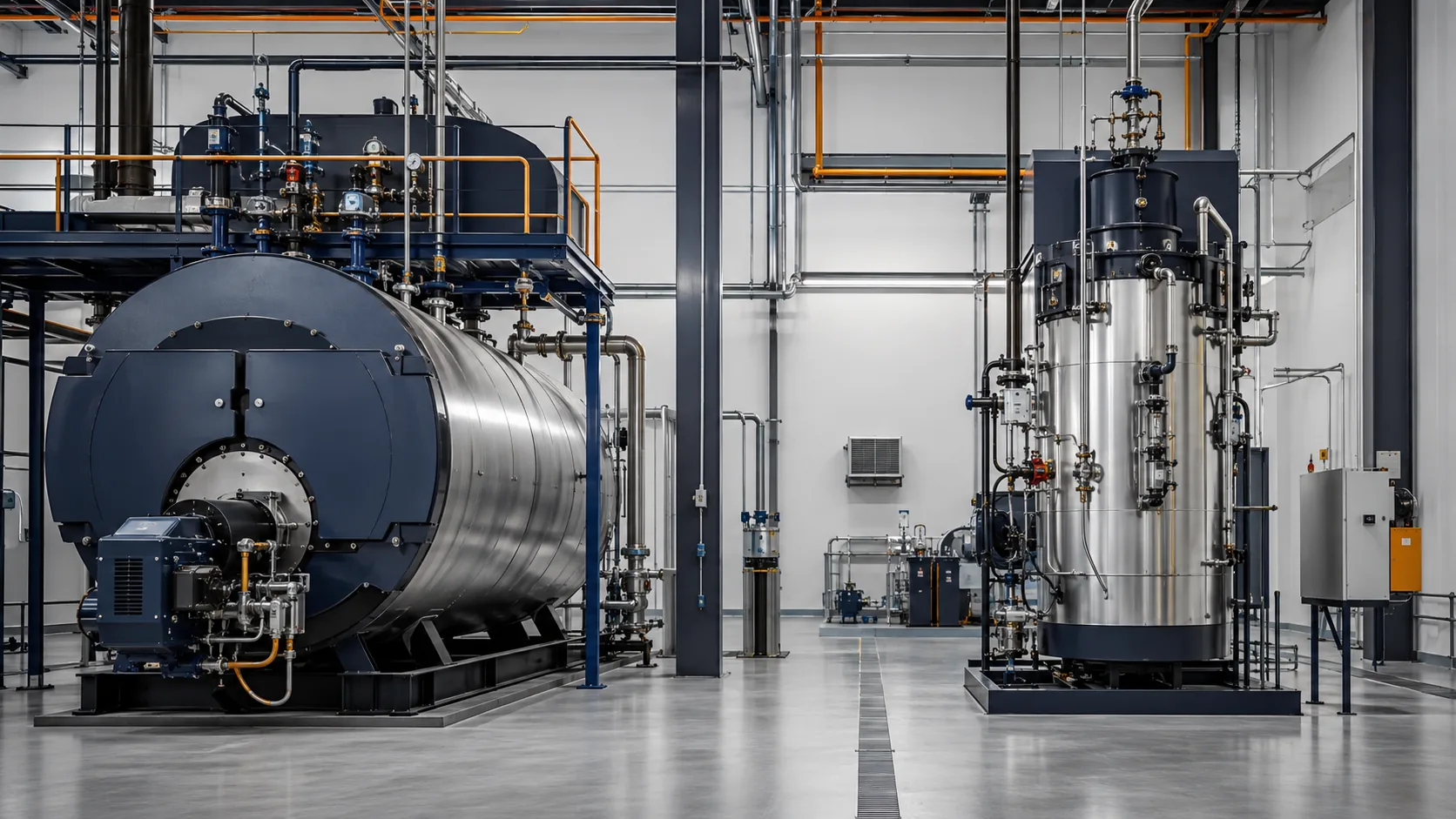
Although the steam boiler and steam generator seem to meet the same need, their operating characteristics are different. The right choice; It depends not only on the hourly capacity, but also on how long the facility needs steam, how variable the consumption is, steam quality and pressure expectations, maintenance schedule and redundancy needs.
The classic steam boiler can be a powerful solution in continuous and high flow production. If fast start-up, more compact installation and intermittent consumption are priorities, steam generator may come to the fore. However, the product name alone is not enough to make a decision; The design, water volume, heat transfer surface and control system should be examined.
Basic operating difference
Classical industrial steam boilers have more water volume inside the body. Combustion gases or heat source pass through the heat transfer surfaces and convert this water into steam. Large water volume can provide a buffering effect during load fluctuations; However, the cold start time may be longer.
In steam generators, water is heated rapidly in a smaller volume circuit. This structure can shorten the initial steam start-up time and provide a compact layout. Feedwater quality, flow control and automation stability may become more critical due to low water volume.
Comparison table
| Decision criteria | Steam boiler | Steam generator |
|---|---|---|
| First steam launch | Usually longer | Usually shorter |
| Water volume | Higher | Lower |
| Response to load fluctuation | Water volume can provide buffer effect | Can provide rapid control; correct automation required |
| Sustained high load | Strong with suitable design | Depends on model and capacity |
| Intermittent operation | Heating loss may be more pronounced | May be suitable for frequently started processes |
| Installation area | Can be larger | Generally can be more compact |
| Steam quality | Stable with correct level and separation design | Water entrainment should be controlled during flow rate |
| Water treatment accuracy | Is important | May be even more critical due to small channels |
| Maintenance approach | Large control surfaces and periodic inspection | Coil/pipe structure and pump control are important |
The expressions in the table are the general trend. Manufacturer’s design and actual operating conditions may alter the result.
For which businesses is a steam boiler more suitable?
The classical boiler can be evaluated in facilities that use stable and high flow steam for long shifts, in applications where the load profile is often close to the nominal capacity, and in cases where short-term consumption increases are required to be balanced with water volume.
If consumption continuity is high in textile, food, paper, chemistry, feed and large process facilities; Boiler selection should be made by calculating capacity, pressure and redundancy. Staggered operation with two boilers instead of a very large single boiler can increase efficiency and operating reliability during low load periods.
For which businesses is the steam generator more suitable?
Businesses where production starts in a short time, where the steam need is on and off during the day, where space is limited or where there is a spot steam demand, can consider the generator. Fast response can be an advantage in laboratory, small and medium-sized process lines, ironing, cleaning and certain food applications.
Electric steam generator should be evaluated separately for applications that do not require combustion and chimney. Decisions should not be made based solely on the initial investment without calculating the unit cost of electricity, facility power infrastructure and operating time.
The most common selection mistakes
Looking at nominal capacity only
Label capacity of 1,000 kg per hour does not mean that the system will perform the same in the actual load profile. Minimum load, start-up time and peak consumption should be examined together.
Ignoring steam quality
Wet steam reaching the process can affect heat transfer, valve and equipment life, and even product quality. Steam outlet geometry, separator need and line drainage should be evaluated.
Seeing water only as an auxiliary subject
If hardness, dissolved oxygen and total dissolved matter are not controlled, scale and corrosion can occur in both systems. Narrow cross sections in generators may be more sensitive to poor water quality.
Considering the boiler room separately from the system
Fuel line, chimney, feed water, condensate return, pumps, blowdown, automation and steam distribution should be designed together. Boiler room installation is not just placing the device on the floor.
Information to be obtained from the business for selection
- Normal, minimum and peak steam consumption,
- Desired working pressure and steam quality,
- Daily working hours and shift patterns,
- Time from cold start to production,
- Condensate return rate and temperature,
- Fuel and electricity infrastructure,
- Future capacity increase,
- Production need during redundant operation and maintenance,
- Boiler room space, chimney and logistics constraints.
Comparison without this data is based on product name; It does not turn into an engineering choice.
Conclusion: Which is more efficient?
One cannot say “the boiler is more efficient” or “the generator is more economical” on its own. A correctly sized boiler may be more suitable for continuous high load, and a generator with low standby loss may be more suitable for fast and intermittent consumption. The most economical solution is the system that produces the steam needed in the annual load curve with the least loss.
Hisarmak considers not only device capacity in the selection process; It evaluates process load, fuel, water treatment, condensate return and site conditions together. Project data can be shared via request form.
Frequently asked questions
Is the steam generator always faster?
Usually faster due to lower water volume; The exact duration depends on device design, capacity, feed water temperature and initial conditions.
Is a steam boiler safer?
Safety depends on correct design, suitability, safety equipment, water quality, trained operation and periodic control rather than the product name.
Should two small systems or one large system be chosen?
The cascade system may be advantageous in variable load. Initial investment, minimum load efficiency, redundancy and maintenance continuity should be calculated together.
Doesn’t a steam generator require a boiler room?
Such a generalization cannot be made without evaluating local legislation, fuel type, pressure, capacity and installation conditions. The opinion of authorized project and occupational safety teams should be sought.